
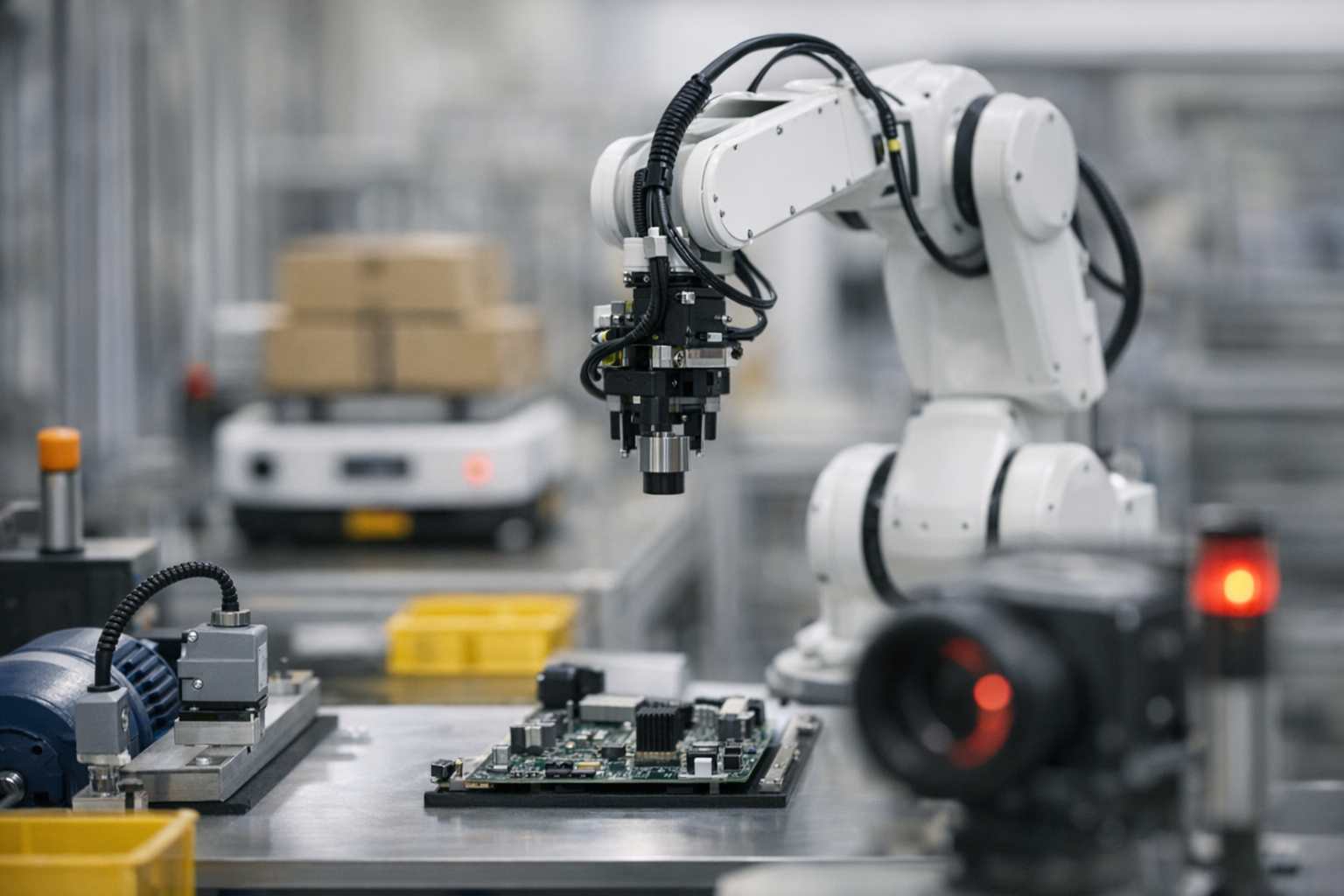
Running a machine-learning model on a device is relatively easy. Building an edge AI system that remains accurate, responsive and maintainable outside the lab is much harder.
The model is only one part of the product. A real deployment also depends on sensors, compute hardware, power and thermal limits, application software, connectivity, security, update mechanisms and a way to understand what is happening across the fleet.
This is what I mean by an edge AI solution: not an exported model file, but a complete system that turns local data into a useful and dependable decision.
Why put intelligence at the edge?
Cloud AI is powerful, but sending every sensor reading to a remote service is not always the right architecture. Processing data close to where it is generated can provide:
- Lower latency: decisions are not delayed by a network round trip.
- Offline operation: the product can continue working with limited or no connectivity.
- Data privacy: sensitive audio, images and operational data can stay on the device.
- Lower bandwidth cost: raw, high-volume sensor streams do not need to be uploaded continuously.
- Predictable behaviour: the critical inference path is not dependent on changing network conditions.
Those advantages come with constraints. Edge hardware has finite memory, compute, storage, power and cooling. The engineering task is to find the right balance rather than forcing a cloud-sized model into a smaller box.
Start with the decision, not the model
The first question should not be “Which neural network should we use?” It should be “Which decision must the product make, and what happens if that decision is late or wrong?”
A useful problem definition identifies:
- the input signals available at decision time;
- the required response time;
- acceptable false-positive and false-negative rates;
- environmental conditions and expected variation;
- the action taken after inference;
- and a safe fallback when the system is uncertain.
These requirements determine the data strategy, model family, hardware and test plan. Without them, optimisation becomes guesswork.
The edge AI development path
1. Build a representative dataset
The data must reflect the product’s real operating environment, not only a clean laboratory setup. Different users, machines, lighting conditions, mounting positions, sensor tolerances and background noise can all change model behaviour.
It is also important to capture the difficult negative examples: inputs that look similar to the event of interest but should not trigger an action. In many products, these edge cases determine whether the feature feels dependable or frustrating.
2. Match the hardware to the workload
Hardware selection is a system decision. A small microcontroller may be ideal for always-on vibration or audio classification. A processor with an NPU or GPU may be better for multi-camera vision, language models or more complex sensor fusion.
The comparison should include more than headline throughput:
| Requirement | Questions to answer |
|---|---|
| Compute | Can the device meet end-to-end latency at the required sample rate? |
| Memory | Do the model, buffers and application fit with safe headroom? |
| Power | Can the product sustain inference within its energy budget? |
| Thermals | Does performance degrade after prolonged operation? |
| Interfaces | Can the platform connect to the required sensors and actuators? |
| Lifecycle | Will the hardware and software stack be supportable for the product’s lifetime? |
3. Optimise with measurements
Quantisation, pruning, operator fusion and hardware-specific acceleration can reduce latency and memory use, but every optimisation should be measured against accuracy on representative data.
Benchmark the complete pipeline—sensor capture, preprocessing, inference, post-processing and application response. A fast model does not guarantee a fast product if data movement or image conversion dominates the execution time.
4. Integrate inference into product behaviour
An inference result is rarely the final action. Production systems often need confidence thresholds, temporal filtering, state machines and domain rules around the model output.
This layer is where statistical predictions become controlled product behaviour. It should define what happens when confidence is low, sensor data is missing, the model times out or the input falls outside the conditions seen during development.
5. Design deployment and monitoring from the start
Models change after launch. New environments reveal failure cases, datasets improve and hardware configurations evolve. A maintainable system therefore needs versioned models, compatibility checks, signed updates, staged rollout and a safe rollback path.
Monitoring should answer whether inference is running, whether inputs are drifting and whether the product’s outcomes still meet the original requirement. Where privacy rules allow, carefully selected telemetry or user feedback can guide the next data-collection cycle without uploading raw data unnecessarily.
Edge, cloud or hybrid?
The best architecture is often hybrid rather than ideological.
| Architecture | Best suited to |
|---|---|
| Edge | Fast control, private data, offline operation and high-volume sensor processing |
| Cloud | Fleet-wide aggregation, large-scale training and compute-intensive analysis without strict latency limits |
| Hybrid | Local real-time decisions combined with central monitoring, retraining and lifecycle management |
For example, an industrial machine might detect an anomaly locally in milliseconds, stop or adjust the process using deterministic application logic, then send a compact event summary to the cloud for fleet analysis.
What production-ready really means
A successful prototype proves that a model can work. A production-ready edge AI system proves much more:
- it works across the expected range of real inputs;
- it meets latency, power and thermal budgets;
- failures lead to defined and safe behaviour;
- software and models can be updated without stranding devices;
- the system can be observed and supported at fleet scale;
- and the architecture remains understandable to the team maintaining it.
That final point matters. The best edge AI system is not necessarily the one with the most sophisticated model. It is the one that delivers the required outcome reliably, within the constraints of the product, and can keep doing so after deployment.
Continue reading
For a deeper look at how these ideas apply to autonomous machines, read Edge AI for Robotics: Building Intelligent Machines That Can Sense, Decide, and Act.
If you are evaluating an edge AI product architecture, you can also get in touch.