
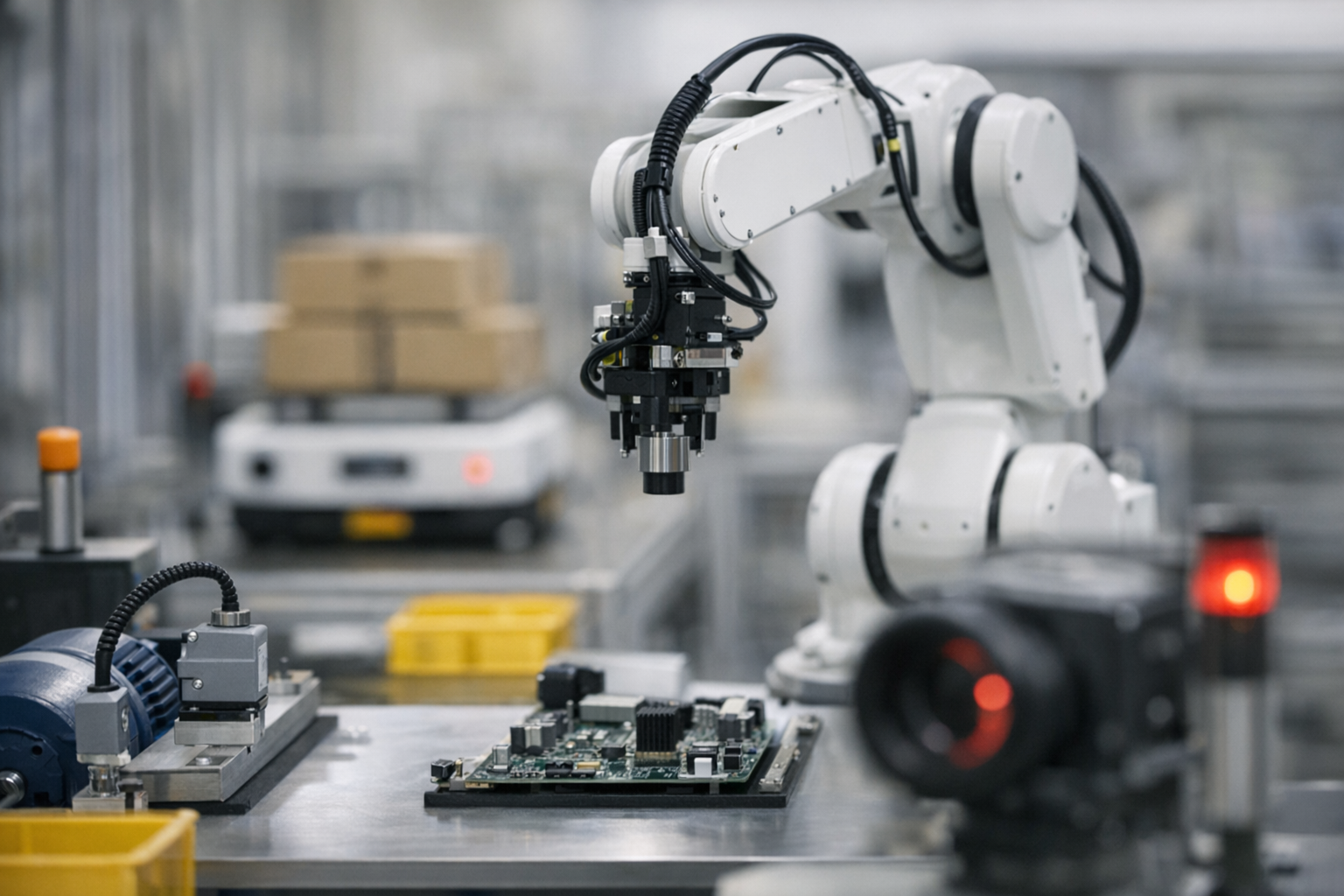
Robotics is entering a new phase. For many years the focus was on what robots could do in carefully controlled environments. Today the challenge is different. Robots are being deployed into factories, warehouses, hospitals, farms, construction sites, and public spaces where conditions change, data is noisy, and humans are part of the environment. In this context intelligence must be reliable, timely, and tightly integrated with physical systems.
Edge AI has become a foundational technology in this shift. It enables robots to process data close to where it is generated and to act on that data in real time. More importantly, it changes how robots are designed, how they respond to uncertainty, and how they scale beyond rigid automation.
From digital AI to physical intelligence
Much of the recent progress in AI has been digital. Language models process text, vision models classify images, and cloud systems analyze data at scale. Robotics is different. A robot must sense the physical world, decide what to do, and act through motors, actuators, and tools. Every decision has timing constraints and physical consequences.
This shift is often described as Physical AI. It refers to AI systems that operate inside machines and interact directly with the real world. Physical AI must deal with gravity, friction, occlusion, sensor noise, mechanical wear, and safety. A delayed or incorrect decision is not just an inconvenience. It can damage equipment, stop production, or put people at risk.
Once AI becomes physical, the architecture matters. Intelligence cannot live only in the cloud. It must exist close to sensors and control loops. This is where edge AI becomes essential.
Why edge AI matters in robotics
Robots generate large volumes of sensor data. Cameras, microphones, encoders, IMUs, force sensors, torque sensors, vibration sensors, and depth sensors continuously produce signals. Sending all of this raw data to the cloud is often impractical due to bandwidth limits, latency, cost, and reliability.
Edge AI allows robots to interpret sensor data locally and send only meaningful information upstream. Instead of streaming video, a robot can transmit that a defect was detected. Instead of raw vibration data, it can report that a motor is deviating from normal behavior. This reduces bandwidth and enables faster responses.
Latency is a critical factor. In robotics, when a decision is made can matter as much as what the decision is. A robot that must avoid a collision, adjust a grasp, or stop near a human cannot wait for a network round trip. Edge AI supports low latency and deterministic timing, which are essential for safe operation.
Connectivity is another constraint. Many robots operate in environments where connectivity is unreliable or restricted. Edge AI allows robots to continue functioning when the network is slow or unavailable. Cloud systems remain valuable for training, fleet learning, analytics, and updates, but local autonomy is required for moment-to-moment operation.
Privacy and data governance also play a role. Robots increasingly operate near people and may process visual or audio data. Processing this data locally can reduce exposure of sensitive information and simplify compliance.
Edge AI compared to fixed automation
Traditional robotics automation is built on deterministic logic. State machines, rules, thresholds, and decision trees are widely used because they are predictable and easy to validate. In structured environments they work extremely well. Fixed automation excels when the world behaves as expected.
The challenge is that real environments rarely remain static. Lighting changes, parts vary, sensors drift, surfaces wear, and humans behave unpredictably. As variability increases, deterministic logic becomes brittle. Thresholds need constant tuning. Rules multiply. Edge cases grow faster than engineering teams can manage.
Edge AI approaches the problem differently. Instead of relying on fixed thresholds, models learn patterns from data. This allows systems to tolerate noise and variation. Rather than failing abruptly when a rule is violated, a learned model can degrade more gracefully.
This difference becomes clear in perception tasks. A rule-based inspection system may rely on edge detection and fixed limits. Small lighting changes can break it. A learned model can recognize textures, shapes, and context across a range of conditions. The same applies to grasping, navigation, and safety perception.
Edge AI also scales better with complexity. Adding new conditions to a rule-based system often requires new logic and extensive testing. With edge AI, improving behavior often means collecting more representative data and retraining. Complexity is absorbed into the model rather than the codebase.
This does not mean edge AI replaces deterministic systems. The most robust robots use hybrid architectures. Edge AI handles perception, interpretation, and adaptation. Deterministic logic enforces safety limits, hard constraints, and verified control behavior.
Core edge AI workloads in robotics
Several workloads consistently deliver value in robotics.
Perception is the most visible. Robots use edge AI to detect objects, identify parts, track items, recognize gestures, inspect surfaces, and understand scenes. This enables robots to respond to what is actually present rather than what was assumed during programming.
Sensor fusion builds on perception by combining signals from multiple sensors. Vision alone can be misleading. Force, motion, current, and depth provide complementary information. Fusing these signals locally improves robustness and reduces false positives.
Anomaly detection is especially powerful in robotics. Many failures are rare and hard to label. Instead of trying to enumerate every fault, systems can learn what normal behavior looks like and flag deviations. This applies to visual inspection, mechanical health, and process monitoring.
Predictive maintenance uses similar techniques to monitor robot health over time. Motors, bearings, joints, and actuators wear gradually. Edge AI can detect early signs of degradation by analyzing vibration, current, torque, acoustic patterns, and timing. This shifts maintenance from reactive to proactive.
Human-robot safety and interaction is another critical area. Robots need to detect people, recognize proximity, interpret gestures, and monitor restricted zones. These decisions often need to be made locally and quickly. Safety-related perception is one of the strongest arguments for edge deployment.
Making models work on physical robots
A model that performs well in a lab or notebook is not guaranteed to work on a real robot. Reliability in physical systems comes from controlling the surrounding factors and designing the full system.
The physical environment must be represented in the data. Models trained on clean datasets often fail in dusty, noisy, or cluttered environments. Data should reflect real lighting, real motion, real wear, and real interactions. If a condition is missing from the dataset, it is likely to appear later as a failure mode.
Sensors deserve careful attention. Many edge AI failures originate from sensor issues rather than model design. Noise, drift, dropped frames, and synchronization errors can all degrade performance. Preprocessing, filtering, calibration, and health monitoring are essential.
Latency and timing must be bounded. Robotics systems need predictable behavior. Inference time should be measured on target hardware, not just in development environments. Systems should include timeouts, watchdogs, and fallback behaviors when deadlines are missed.
Hardware constraints shape what is possible. Robots operate under limits on memory, compute, power, and thermal headroom. Model size, memory footprint, and energy use must be considered early. Hardware-aware optimization and profiling are part of model design, not an afterthought.
Safety must be treated as a system property. Models will fail at some point. What matters is how the robot responds. Action limits, sanity checks, redundancy, and deterministic guardrails should surround learned components. Models can propose actions, but controllers and safety systems should enforce constraints.
Reliability also depends on lifecycle management. Deployment is not the end. Performance can drift as environments change. Monitoring, logging, confidence tracking, update mechanisms, and rollback strategies are required to keep systems operating safely over time.
Local reasoning and the next layer of intelligence
Recent progress in local language and vision language models adds another layer to robotics. Edge AI has already improved perception. Smaller language and multimodal models make it possible to add local reasoning and instruction understanding.
These models can help robots interpret scenes, understand task instructions, and plan actions at a higher level. They are most effective when used as part of a layered architecture. Fast perception models handle immediate signals. Local reasoning models interpret context. Classical planners and controllers execute actions within safety bounds.
Vision language action models push this idea further by connecting perception and language directly to actions. They are an active area of research and development. While promising, they do not remove the need for validation, control, and safety systems. They fit best as part of a broader stack rather than as a single controlling intelligence.
Architecture for practical physical AI
The most effective robotics systems follow a layered approach. Cloud systems handle large scale training, simulation, fleet learning, and analytics. Edge systems handle perception, local reasoning, sensor fusion, and anomaly detection. Real time controllers handle motion planning, servo loops, and safety interlocks. The physical world provides continuous feedback that drives improvement.
This hybrid architecture balances flexibility with reliability. It allows robots to learn collectively while acting autonomously in the moment. It also reflects a shift in mindset. Intelligence is no longer confined to a central system. It is distributed across the robot and its ecosystem.
Looking ahead
Edge AI has moved from an optimization to a design requirement in robotics. As robots leave controlled environments and enter the real world, intelligence must operate under constraints and uncertainty. Edge deployment supports low latency, autonomy, privacy, and robustness. It also enables new capabilities that fixed automation struggles to deliver.
Physical AI provides a useful lens for this transition. It emphasizes that intelligence in machines is not just about models. It is about systems that sense, decide, and act safely in the real world. The robots that succeed will not be defined by the size of their models. They will be defined by how well intelligence is integrated with hardware, data, control, and safety.
Cloud AI helps robots learn from scale. Edge AI helps robots act in the moment. Together they form the foundation for the next generation of intelligent machines.